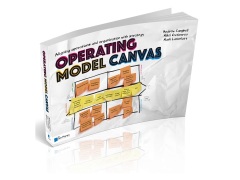
The Operating Model Canvas

Remember you found it here first: The Operating Model Canvas. The idea is to build on the popular Business Model Canvas which does not flesh out the operating model to the level of detail that most leaders need.

Half of the Business Model Canvas is devoted to customers, channels and value propositions. This leaves less than half for operating model elements – Key Activities, Key Resources and Key Suppliers. The Operating Model Canvas goes much further than this.

In this blog you are going to get just a flavour of the Operating Model Canvas. In later blogs I will flesh out the ideas more fully and, hopefully, provide a visual.

An Operating Model Canvas (OMC) can be developed for each stakeholder or beneficiary and for each type of benefit (or value promise or value proposition). It is particularly important to develop a different OMC for each different value chain (or activity chain or process steps). So, for my business, I need to do an OMC for the delivery of courses to executives and another OMC for the delivery of breakthrough research and a third for the management of a network of strategy executives. In addition, an integrated OMC is then created to show how the three OMC’s are linked together. If the OMCs are highly integrated rather than divisionalised as is the case for the Ashridge Strategic Management Centre, it is hard to design one OMC without considering how it will fit with the others.

The Operating Model Canvas captures the main elements of the operating model in a way that makes it possible to then design the details – processes, information architecture, decision structures, committees, job descriptions, KPIs, incentives, people policies, office and factory space, etc.

So what does an OMC cover. On the right hand side is the customer or beneficiary. An arrow points at the customer defining the “value promise”. To the left of the arrow are three columns taking up the rest of the page. The first (closest to the arrow) is headed “Process Steps”. This space is used to draw the value chain or list the process steps needed to deliver the benefit. Next comes the “Enablers” – SPLITS – Skills, People, Locations, Information, Technology and Suppliers. The important consequences for each of these six elements are listed here. The final column is headed “Organisation Model”. This space is used to draw an organisation chart as an organisation model (special tool for this) or just describe the core elements of the organisation.

Since first writing this blog – the tool (operating model canvas) has become fully defined and developed.  It is now explained in a book, a video and a website.

Posted in Operating Model Canvas | Tagged , , , | 3 Comments

Value chains and operating models

At a recent workshop we were using value chain analysis to help us with operating model design. This has made me wonder whether it might be possible to do this work in a more structured way.

The idea in my mind is this. Lay out the offers that the organisation is making to each stakeholder. For example, the Ashridge Strategic Management Centre promises brilliant courses for executives, brilliant research about critical management topics for publishers, editors and managers and a thoughtful network that discusses strategic issues to heads of strategy.

Then lay out the value chains needed to deliver each offer. The value chain for running brilliant courses is as follows – develop course idea, test idea with sample audience, test out some sessions with sample audiences, assemble and enthuse faculty, test market, adjust marketing, full marketing, administer applications from participants, prepare materials, deliver sessions, collect feedback, revise sessions, etc.

This value chain or process map is different from that needed to do research and from that needed to create lively discussions in a strategy network.

By laying out these different value chains/processes, it is much easier to see the challenges that will need to be resolved in the design of an integrated operating model. In some places there are connected steps across different value chains. For example, research generates new ideas which are often best tested out in the classroom. Also, questions from the classroom often stimulate interesting new research avenues. It is quite challenging to design an operating model that will ensure these links work. The Strategic Management Centre does this by making sure that it is the same person who teaches, does research and interacts with the network. But this creates other problems, such as how you find people who are good at all three.

Also, the Centre has other stakeholders – the business school, the Centre’s directors, the Centre’s staff. The operating model must also deliver satisfaction to these stakeholders. Hence each value chain can be interrogated for its impact on the brand and finances of the business school, the motivation of directors and the engagement of staff.

So value chain analysis of this sort could be a structured part of the process of designing an operating model. I prefer thinking of it as value chain analysis rather than process mapping because what you are looking for initially is a high level process map with maybe only four or five major steps in each process.

Posted in Value chain | Tagged , , , , | Leave a comment

Designing top down and bottom up

It is not possible to design everything at once. So should you start at the top and work down or start at the bottom and work up?

Form follows function suggests that you should start at the top – what is the strategy and hence what do we need to put in place to execute the strategy? But, it is not as easy as that.

So this is what I find works. Start with strategy. Then identify the main modules of work or chunks of activity or units that will be needed to implement the strategy.

Then switch to a bottom-up approach. Choose a few of the modules or chunks that you have identified that you think will be likely to affect other parts of the design and dive down into the detail. Be prepared to get into the smallest details if you think it will help. Lutchens even designed the door knobs of the Viceroy’s palace in India.

Then use the insights you have gained from working on a part of the detail to help you reconsider the modules and put in place the connections and links.

Then, with the high-level design in place, you can delegate the design of each module to those with the appropriate level of understanding.

The approach requires the ability to shift between the higher and lower levels without loss of enthusiasm or perspective. Some people are bored by the details. Some are only happy when they are working with something tangible and practical. Some get lost in the plumbing. Some remain in an ivory tower. Good design work is about taking as much pleasure in observing the way an operative does her job as in drawing up a plan for a global manufacturing footprint.

Posted in Design steps | Tagged , , | Leave a comment

Business Models and Operating Models

Posted in 2014, edited in 2018.

What is the difference between a business model and an operating model and who cares? First, I don’t think that it matters how you define terms like business model or operating model or business architecture. But it does help to be consistent. In this blog I will offer some definitions, not because I think they are more right than other definitions but because, in order to develop definitions, you need to think through all the moving parts.

For me a business model is the larger concept. An operating model is a part of a business model. An operating model is the engine at the heart of the business model that helps make the business model work.

A business model defines the following
– the stakeholders with whom the organisation will interact, particularly the “mission stakeholder” or “customer”
– the offer or promise that the organisation is making to the mission stakeholder – often referred to as the “value proposition”
– the resulting financial model (income statement and balance sheet) taking account of size and growth ambitions
– the operating model that makes it possible for the organisation to deliver the value proposition

This is consistent with the Business Model Canvas.   So, my way of defining a business model (similar to the Business Model Canvas) makes the operating model a subset of the business model.

The operational end of the Business Model Canvas consists of Key Activities, Key Resources and Key Partners.   This is a form of operating model, but, as you will see below, I think we can do better than that.

My definition of an operating model is:
– the core work processes that are needed to create and deliver the value proposition (the products or services or benefits that the organisation chooses to provide for its “customers” or “beneficiaries”
– the equipment and technology needed to execute these core processes
– the information systems needed to support these core processes
– the processes needed to support the core processes, such as financial processes or HR processes
– the suppliers needed to support the processes and the supplier agreements needed to keep the most important suppliers engaged
– the people needed to do the work and the “offer” that will attract and retain these people
– the organisation structure, decision rights and accountabilities needed to ‘govern’ and support the people
– the cultural context that will help the people be effective
– the locations, buildings and ambiance where the core and support processes will be executed

– the calendar of management meetings and scorecard needed to run the organisation

Some people use the short hand of People, Process and Technology to describe an operating model.  The Business Model Canvas refers to activities, resources and business partners.  My own shorthand is POLISM – Processes (in the form of value delivery chains), Organization, Location, Information, Suppliers and Management systems (planning, budgeting, etc).  All this is covered in the book Operating Model Canvas , on a YouTube video The Operating Model Canvas as well as on my course at Ashridge Executive Education Designing Operating Models

The comments below were made before the latest edit so may be addressing some part of the article that has been changed

Posted in Business model, OM frameworks, Strategy | Tagged , , | 8 Comments

How to clarify strategy

When designing an operating model or business architecture, the team are often confronted with the issue of needing to clarify the strategy. For example, how many new service areas is the company planning to develop or how important are back office synergies versus local flexibility and initiative or is product innovation more important than tailored solutions or vice versa?

Why are these kinds of issues not made clear in the strategy? The strategy usually focuses on ambition “we will grow by developing new service areas” or “we will improve margins by exploiting back office synergies” or “we will be market-led”. Strategic plans often fail to explicitly address the dilemmas that are so important to operating model design – “is close to the market more important than technical innovation?” – because leaders are focused on defining a path forward rather than a blueprint for implementation. As those who work on the blueprint get closer to those who develop strategy, there is more potential for these issues to be addressed in the strategic plan. But, currently, in most companies, the enterprise architects or business designers do not usually have much dialogue with the strategic planners while the strategy is being developed.

The best way of solving the problem of unclear strategy is to use scales, laying out the choices that need to be clarified so that the extreme positions are at either end of the scale. So one scale might be market-led versus technology-led. Another scale might be one new service versus six new services. Another scale might be total back office unification versus only unify the low hanging fruit or only unify those activities that do not reduce local flexibility. These scales can then be presented to the strategists or top team for debate. The current strategy can be positioned on these scales where it is clear, helping to expose where more clarity is needed. Also, by laying out the scale, this tool helps strategists realise that they need to explain why a particular choice has been made. It is these reasons why, that are often most helpful to those designing the operating model. (see previous blog on developing good design principles).

Posted in Design principles, Design tools, Strategy | Leave a comment

The power of stakeholder analysis

Today I was with the Exco of a company doing a “strategy refresh”. One of the exercises we did was a stakeholder analysis. Who are the stakeholders – customers of various types, shareholders, bankers, suppliers, employees, regulators, etc.

We then asked “what is our planned offer for each of these stakeholders”. In other words, why should the stakeholder care about us? Interestingly, in the company concerned, there were a couple of stakeholders who did not care, and it was difficult to think of a way of incentivising them to care. Both were public/government organisations. Fortunately, neither was deemed critical to future success.

Getting clarity about what the company was offering each stakeholder took an hour.

We then asked which of these offers is difficult to deliver and why. As it turned out there were two particular stakeholders that were difficult to satisfy, mainly because of competition but also because one stakeholder influenced the satisfaction of the other, but was not prepared to invest anything to help raise satisfaction.

The process gave insights into the critical strategic challenge facing this company – an important ingredient of good strategy as argued by Richard Rumelt in Good Strategy Bad Strategy.

I have rarely found that an analysis of stakeholders does not give insights to those who do the analysis. What is more, it is an excellent starting point for operating model work.

Posted in stakeholders | Leave a comment

Getting started on an operating model

I have been wrestling with the issue of how to get started on the design of a target operating model. My thoughts are as follows:

1. Start with the strategy
2. Convert the strategy into promises/offers for each stakeholder and consider which promises will be “difficult” to achieve. Try to understand what makes the promise difficult to achieve, and, therefore, what the organisation will need to do particularly well in order to overcome the difficulty. Convert these thoughts into design principles.
4. Lay out the main work streams or value chains or operating steps thinking about where the organisation will have special capabilities. Convert these thoughts into design principles.
5. Create a “rough sketch” design – ideally on one page
6. Convert that design into an organisation model showing the main parts of the “operating work” and the “support work”
7. List and draft a design for the critical management processes that cut across the organisational boxes of the organisation model
– important decision processes (about what will be done – i.e. decision and planning processes)
– performance management processes (target setting, accountability, monitoring progress and adjusting)
– people decisions
– processes for changing the operating model (often confused with decision and planning processes)
8. Consider the “events” that create interactions with stakeholders, with special attention to those that are difficult (see 2 above). Identify and draft the processes that are needed to make the events successful. Focus on those processes that require reactions from more than one “box” in the organisation model. Those that only involve one box can be designed by the leader of that box (e.g. agreeing a price with a customer – by sales).
9. Work through the detailed design of each process using PILOS (Process/equipment, Information technology, Locations/properties, People, Suppliers)
– equipment/technology needed (consider technology developments such as digitization and mobility)
– locations and property needed
– people needed
– information systems needed
– suppliers needed
10. Finalise process architecture and process owners, technology plans, property plans, people plans, information system plans and supplier plans.

Of course this implies a linear approach working from strategy to detail. In practice it is a more iterative approach where some work on detail is done to inform steps 5 and 6.

An observation. This flow does not include a “capability map” (see thoughts about capability maps). .

Posted in Design steps | Leave a comment

The role of processes in an operating model

How far should an operating model include information about processes? The answer to this comes from two directions. First it is a question of levels of design. At the highest level of design, the only process that is relevant is the overall value chain – how value is created. At the lowest level of design, every process needs clarifying at whatever level of detail is needed. Its like the design of a house. At the highest level of detail you do not need to know where the kettle is going to be plugged in. But, at the lowest level, this is important because you may need an extra electric socket above the kitchen surface. So one answer is that “it depends”.

The other answer to the question came to me today as I was wrestling with some issues in a business where assets and infrastructure are critical. The issue we were discussing concerned the process for developing the business case for a new asset. The process was complicated because it involved at least five functions, each contributing important elements not only to the numbers, but also to the design of the asset and to the commercial importance of the asset.

The person I was talking to was the head of asset management. He was gradually putting in place processes and roles around these decisions. He pointed out that this was happening between peers at two levels below the top management team. He did not want the top management team to get too closely involved because he was afraid that they would impose impractical solutions. This was, in his opinion, an issue that could only be resolved at his level. The analogy is that you do not want the architect to decide where the kettle will sit.

However, because asset decisions are important, and because the top management team are often influential in these decisions, they do need to understand the process, even if they have not designed it. If they understand, they are less likely to disrupt the process with inappropriate interventions and they are more likely to be able to make helpful contributions. In other words a description of the main processes does need to be part of the operating model at a high level.

This means that it is important to identify and do some design work on the four or five most important decision or management processes, especially those that enable the organisation to work across the boundaries of the primary structure. Within the boxes of the current structure, the leader of each box can design the processes. To go back to the house analogy, the architect does need to understand how the heating system will work, how the family like to entertain and which room the occupants are likely to be in at different times of day. But, he does not need to know how the family prepare tea for breakfast.

Armed with this insight, I am going to encourage the group I am working with this week to identify the four or five main processes in their company and whether a commonly understood process exists or not.

Posted in Lean, Op Excellence and Op Model, Levels of design, Value chain | Leave a comment

How clear does strategy need to be?

One issue that always comes up when doing work on business design or operating models is the question of a lack of clarity about the strategy. For example, the strategy says that the company will develop winning products and be closer to customers and be the lowest cost supplier. Or the strategy does not make clear whether the company is likely to diversify into new service areas or not. There are many ways in which the strategy can be unclear.

The text book advice is “you can’t make a plan until you know where you are going”. The implication is that you should stop work on operating models and processes and demand that more effort is put into clarifying the strategy.

This advice is usually unhelpful. The main reason is that it often takes a long time to clarify strategy. Not only does it involve a lot of analysis, but it is also often quite political. Managers need time to argue out differences of view. In addition, it is often necessary to experiment your way into a new strategy. In other words, most business design work or business architecture work needs to be done despite a lack of clarity about strategy.

My solution is to develop good design principles. Often it is not necessary to have all the strategy dilemmas solved to produce good design principles. Moreover, the process of producing good design principles will help move the strategy forward. Often the lack of clarity means that it is impossible to choose a precise point on one of the scales inherent in a design principle. This is OK. Often the strategy can at least define a direction of movement on the scale. But, the lack of clarity also has implications for the design: it should be flexible or easy to evolve and change, given the possible twists and turns of the strategy.

Posted in Strategy | Leave a comment

Design principles – how do you get good ones?

Most experts on organisation design or operating model design or enterprise architecture will tell you that you need to define your “design principles” or “design criteria” before you start developing solutions.   The design principles tell you what “good” looks like.  They help you narrow the range of solutions you should consider.  They help you choose between alternatives.  They help you keep aligned as you get further and further into the detail.

But how to get good design principles.  Phrases like “lean and efficient”, “with the minimum number of layers in the hierarchy” or “more customer oriented” are common.   But, in this form these phrases are not very useful.

There are two things you can do to help improve your design principles.   First, try the negative.  If the negative is not realistic, you have some work to do.  So “not lean or efficient” is clearly nonsense, implying that this design principle needs some work.  “Not customer oriented” is more possible.  The opposite might be “product oriented” or “technology driven”.    So, identify a negative or an opposite that makes some sense – showing that there is a real choice.  Then consider all the points in between the opposite and the idea you started with.  For example, the points could be “product oriented”, “product led, but with customer sensitivity”,  “customer led, but with product experts”, “customer oriented”.   This then raises the question where on this scale do you want your company to be.  Often the answer is “Ah .. we want to move from ‘product oriented’ to ‘product led, with customer sensitivity’.  We don’t want to lose our product leadership.”   This then becomes the design principle.   Much more useful than the simple sentence “customer oriented”.

For the phrase “lean and efficient”, the scale might be “committed to superior technology” at one end and “lean and efficient” at the other.  It might also be “committed to customer needs” at one end and “lean and efficient” at the other.

With each scale you are trying to articulate a real strategic choice.  This helps you avoid producing platitudes.

Once you have chosen a scale for each design principle and a point on the scale, you then need to ask the question why.  In fact you may need to ask this question a few times: the five whys.  You want to become as clear as possible about why you are choosing this point on the scale rather than the other points on the scale.   These reasons why will be really helpful to you when you are facing tricky design compromises.

Finally, you need to ask your self what the implications of the design principle are.  If the design principle is  “product led but with customer sensitivity”, then the implications might be things like:

– Some people taking a customer perspective who have influence on product development and customer experience

– Some research into customer needs and customer experience

– Some segmentation of customers

Following this way of refining design principles, it is also useful to summarize each design principle in a table that has three columns

– the design principle

– the reasons why

– the implications

We use this approach on the Ashridge course “Designing Operating Models” http://www.ashridge.org.uk/dom

Posted in Design principles, Design steps, Design tools | Tagged , , | 5 Comments